
Contents 9 sections · 9 subsections▼
- What an ideal customer profile is
- Why build a profile when the platforms already choose your audience
- The five layers of a good profile
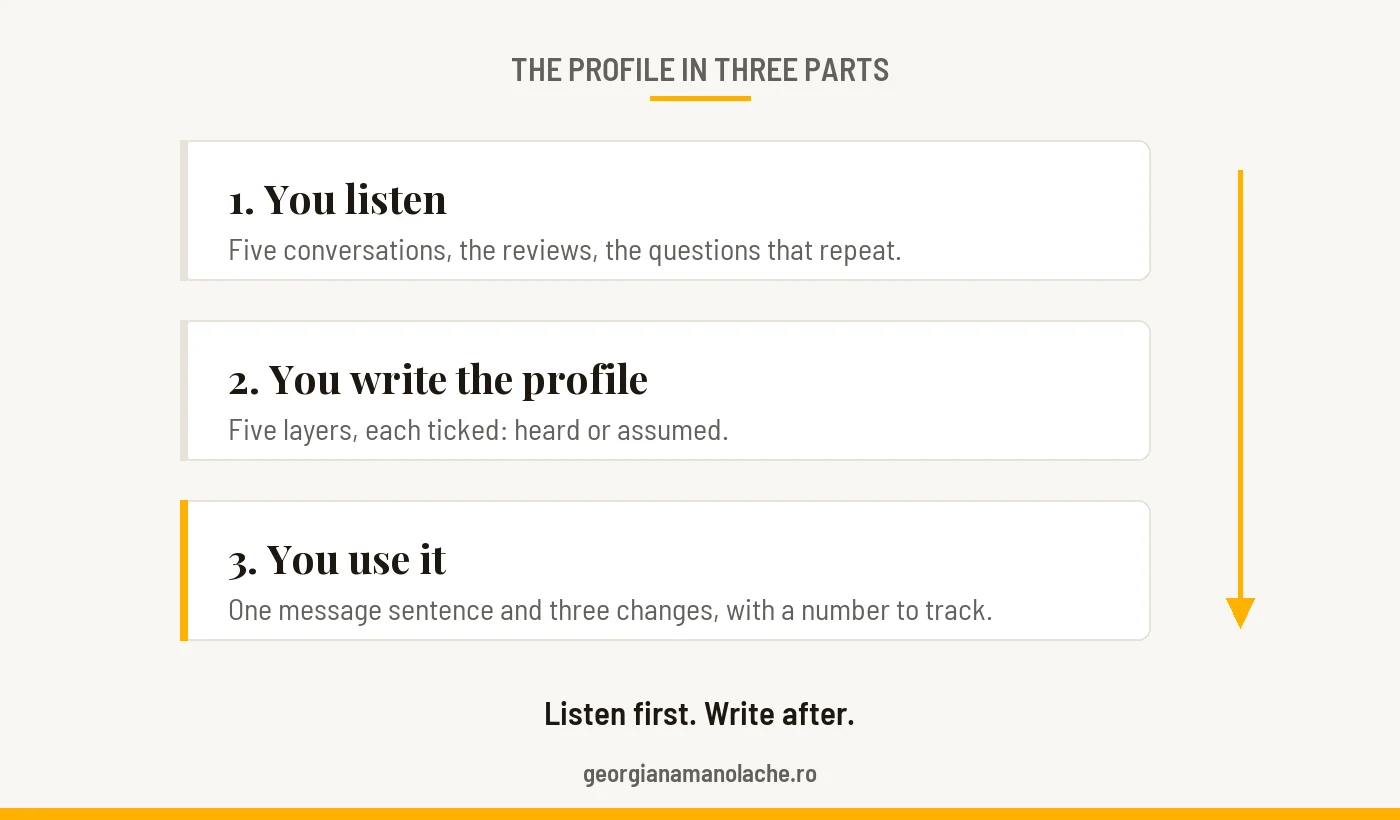
- How to build the profile yourself, in three parts
- First, you listen
- Then, you write the profile
- Finally, you use it
- The mistakes that make a profile useless
- The profile and personal data
- Download the worksheet
- Frequently asked questions
- What is an ideal customer profile?
- What is the difference between a target audience and an ideal customer profile?
- What is a buyer persona?
- Why build a profile if the ad platform chooses my audience?
- How do I build a profile if I'm just starting out and have no customers?
- How often should the profile be updated?
- About the author
An ideal customer profile describes the person you want to sell to: what hurts them, how they decide, when they start looking for you, where you can find them and the words they use. Ad platforms let you choose who sees an ad by age, area or interests. The profile tells you what to say to them, and in which words, so they recognise themselves in your message.
I once asked a client who she was paying to show her ads to. She told me honestly that she didn’t know. She just boosted the post and that was it.
I suggested a little thought experiment: take out of the bank all the money she had spent on ads so far, go out into the middle of the street and hand it out to everyone walking past. People would take the money, of course… but most of them would have no interest at all in what she sells. They wouldn’t even glance at the shop window.
Ad platforms help you stop handing money out to just anyone, because they let you choose age, area and interests. But the part that hurts most is still there after you’ve chosen well: you may be selling exactly what the person is looking for, and if you don’t say it in their words, they won’t even notice you!
In this article I show you how to find those words, step by step, with a single example from start to finish (a neighbourhood cake shop) and a worksheet you can download for free at the end.
What an ideal customer profile is
An ideal customer profile is a portrait of the customer who fits what you do best and whom you’d like to meet more often, built from what hurts them, how they decide and the words they use. You start from real customers and write down what they have in common. In my book I wrote that profiling your customer is an act of empathy: you do it to understand how you can help, without convincing anyone by force.
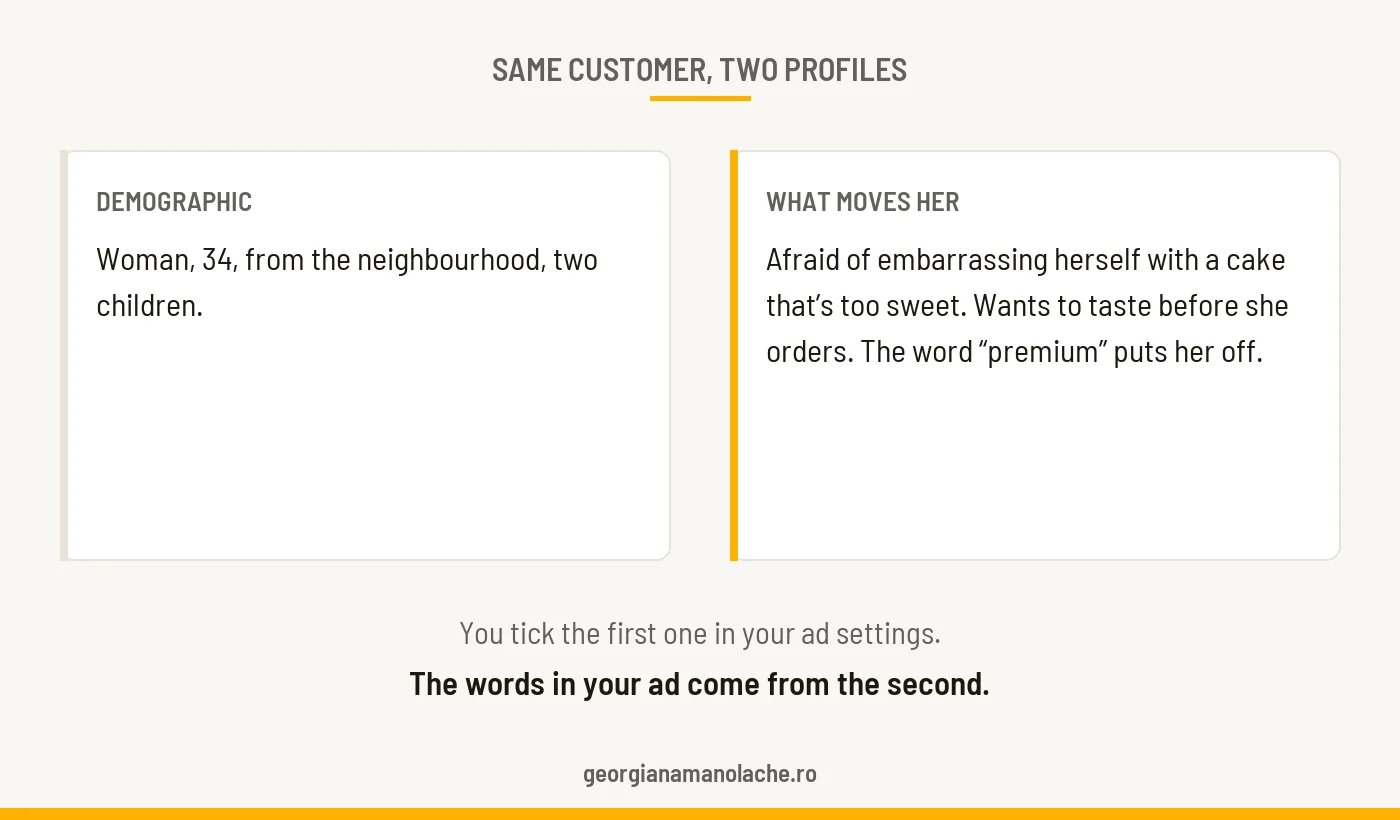
Most of the “profiles” I see look like a census form. For the cake shop in our example, it would read: women, 25-55, from the neighbourhood, average income. It looks like work has been done. Except that none of this says anything about why someone buys.
Here is the same cake shop customer, described in two ways:
| Type of profile | What it looks like |
|---|---|
| Demographic | woman, 34, from the neighbourhood, two children |
| Behavioural | afraid of embarrassing herself with a cake that’s too sweet, wants to taste before she orders, the word “premium” puts her off |
The first row helps you with the ad settings. To know what to write in the ad, you need the second.
You may also have come across the terms “buyer persona” or “customer avatar”. Many templates with those names ask you to invent a name, a photo and a life story for your customer. The profile in this article starts from what real customers say, not from stories and inventions. A target audience is something else: the broad group of people you speak to, and the profile describes the typical customer you want from within it.
If you want to work on your own business as you read, the worksheet is free, and you can also download it at the end of the article.
Why build a profile when the platforms already choose your audience
Ad settings decide who sees the ad, and whether that person stops or scrolls on depends on what they find in it, that is, on the words and the image you chose based on the profile. And even the part about who sees it is not as precise as it looks.
In 2016, Nielsen analysed more than 6,800 campaigns in France, Germany, Italy and the United Kingdom. Campaigns targeting people aged 25 to 54 reached them in 56% of impressions. Those targeting only people aged 25 to 34 (so a much narrower target) hit it in 27% of impressions (in other words, worse)!
Audiences bought from data vendors don’t solve the problem either. A study published in Marketing Science in 2019 tested 90 audiences sold by 19 such vendors. On the simplest criterion, gender, those audiences were on average no more accurate than random selection.
So your ad reaches plenty of people it wasn’t meant for anyway, and the only thing you fully control is what it says. If the text speaks the language of the right person, they stop, even if the ad has also passed by a hundred other people.
Words matter more than they seem to. In my book I explain why: around 95% of the decisions we make are influenced by unconscious, emotional and automatic processes, and reason only comes afterwards, to justify them.
Here is what that looks like at the cake shop. It sells exactly what the mother ordering her child’s birthday cake wants: a cake that tastes good and isn’t too sweet. The website, however, says “unique creations made with premium ingredients”. The mother sees the photo, doesn’t recognise herself in the text and moves on, to the cake shop that talks to her about taste.
The five layers of a good profile
A good profile has five layers: what hurts them, how they decide, the moment they need you, where you find them and how they talk. Demographics stay, but they come last, as packaging. For each layer I give you the example of the same cake shop.
1. What hurts them, but they don’t say. Their main fear, the one they don’t admit easily. Their disappointments with the people they went to before. The promises they no longer believe, because they’ve heard them too many times. At the cake shop: the fear of embarrassing herself in front of her guests with a cake that looks lovely and is hard to eat, after it happened to her once at a big cake shop. “Premium ingredients” means nothing to her any more, because it’s written on every shop window.
2. How they decide. How quickly, on which criteria and in what order, what stops them at the last moment and who else has a say. At the cake shop: she orders about two weeks ahead, chooses by taste and by what the other mums in the neighbourhood group say, and what holds her back is the fear that she has left it too late. The child chooses the theme, the husband looks at the price. If you sell to businesses, this layer counts double: there, the person who uses it, the one who decides and the one who pays are often three different people.
3. The moment they need you. The layer many people skip. In what situation does the person start looking for you? At the cake shop: the child’s birthday, a christening, the nursery end-of-year party, a visit from the in-laws.
Why does it matter? Researchers at the Ehrenberg-Bass Institute call these situations “category entry points” and recommend that a brand be linked to 5 to 8 buying situations like these, chosen where competition is weaker. On top of that, John Dawes’s 95-5 rule, from the same institute, says that at any given moment around 95% of your potential buyers are not ready to buy. If your messages only speak to the person ready to pay today, the other 95% get no reason to remember you when their moment comes.
This is also where you note how ready the person is to listen when they first reach you. In my book I use five stages, inspired by Eugene Schwartz: they don’t know they have a problem; they know about the problem, but not the solutions; they compare solutions; they’ve heard of you, but hesitate; they know you and are just waiting for the right moment. Each stage needs a different message. The mother at the cake shop is at the third: she compares a homemade cake, the supermarket and the cake shops. I’ve also written about the link between these stages and your text in what is copywriting.
4. Where you find them. Online: which networks they use, where they look before buying, at what time and on which device. And in the real world: which streets they walk, where they spend their time, which communities they belong to. At the cake shop: the neighbourhood mums’ group on Facebook and WhatsApp, the Instagram accounts of recommended cake shops, in the evening after 9 pm on her phone, plus the nursery and the park by the block of flats. For a local business, this layer shows whether a poster, a partnership or your Google Business Profile brings more than an ad.
5. How they talk. Their words for the problem and for the solution, the phrases that draw them in and the ones that put them off straight away. At the cake shop, the mums say “it has to taste good, anyone can make it look pretty”, “like homemade”, “not too sweet”. The website says “gastronomic experience”. The words on the website that never come up in what they say are the first ones to change.
How to build the profile yourself, in three parts
You build the profile in three parts: first you listen to what customers say, then you write the profile from what you heard, and finally you use it in three concrete changes. Preparation takes about an hour, the conversations a few days (15-20 minutes each) and pulling it together another hour.
First, you listen
You start from the customer who fits what you do best and you talk to five customers, starting with them. You ask for just a few minutes, on the phone or over a coffee, because a small request gets a “yes” more easily; once it gets going, the conversation usually lasts 15-20 minutes (a form sent by email gets polite, short answers, while on the phone people tell stories). The cake shop owner could write to them like this: “I want to change a few things and I’d like to start from what my customers tell me. Do you have 5 minutes this week, on the phone or over a coffee here, on the house? I promise I’ll just listen.”
The questions that open people up the most all take them back to a moment they lived through, because that way people tell stories; asked what they would like, they usually answer vaguely:
- What brought you to us, and what was going on at the time?
- Before you came to us, what else did you try and what didn’t you like?
- What annoyed you most while you were looking?
- What were you afraid would go wrong?
- Which options were you torn between, and what made you choose us?
- What almost made you give up or put it off?
- If a friend asked you about us, what would you tell her?
For every interesting answer, ask “can you give me an example?” and write the words down exactly as the person says them, even if they sound clumsy to you. In my experience, after about five good conversations the answers start to repeat themselves. At the cake shop, three out of five mothers mentioned, without being asked, a pretty but far too sweet cake bought elsewhere, and four out of five said the tasting convinced them.
Then you read the reviews, yours and those of 2-3 competitors, especially the 1-3 star ones. That’s where people say plainly what hurts. At a big cake shop in town, the owner would find: “It looked amazing, but it was far too sweet” and “Shame you can’t taste anything beforehand”. In other words, exactly the gap she can fill.
And you collect the questions that keep coming up in messages, comments and on the phone. At the cake shop, “Can I taste before I order?” is the question whose answer deserves a place on the website before anyone has to ask.
Then, you write the profile
You reread your notes and underline what comes up with at least two people. Then you go through the five layers and, next to each answer, note where it came from: it’s heard if you underlined it, otherwise it’s assumed. At the end you count the assumptions. Each one is a question for your next conversation. My recommendation: if more than a third of your answers are assumptions, have two more conversations before you use the profile.
Only at the very end do you fill in the packaging: age, area, occupation. It helps you choose where to show up.
Finally, you use it
You write your message in a single sentence, in the person’s own words, starting from what hurts them and what held them back. At the cake shop: “The cake your guests will praise for its taste too, ordered in good time, so you don’t have to worry in the week of the party.”
Then you put it to the test: if they were standing in front of you, would you say that sentence exactly like that? Did you use words you heard from customers? Does it also answer what holds them back? And the best test is an outside one: read the sentence to a customer and watch whether she says “yes, exactly”.
And you choose three places to rewrite this very week, plus one number you track before and after:
| What the cake shop changes | How it is now | What it becomes |
|---|---|---|
| The website headline | “Unique creations made with premium ingredients” | “Birthday cakes for your child that taste good and aren’t too sweet. Taste before you order.” |
| A post | a photo of the cake in the window | an invitation to the Saturday morning tasting, where you taste the slices you choose your cake from |
| Where and when it shows up | random posts at lunchtime | a post in the neighbourhood group, with the admin’s permission, in the evening after 9 pm, and a poster at the nursery, with the nursery’s permission, three weeks before the end-of-year parties |
The number the cake shop tracks: how many birthday cake orders come in per month, before the changes and in the month after.
You’ll find all the questions, with space to write, the “heard” and “assumed” ticks and the cake shop example at every step in the worksheet below.
The mistakes that make a profile useless
Four mistakes are the ones I see most often: the profile stops at demographics, it’s written from assumptions, it’s used only to narrow the ad audience, or it’s left forgotten in a drawer.
A sheet with age, gender and income, without a single fear or a single word from the customer, is still just a hypothesis. So is a profile written from behind a desk: it describes an invented customer, and your text ends up speaking to someone who doesn’t exist. That’s why the “heard” and “assumed” ticks in the worksheet are so useful: they show you on their own how much you guessed.
If you use the profile only to squeeze the ad audience as tight as possible, the Nielsen data above shows how often a narrow target misses. The profile does its best work in your words, so that when the right person comes across your ad, they feel straight away that it’s about them.
And one more, which almost all of us are guilty of: we build it once and forget it. Customers change, and so does the market, so it’s worth rereading at least once a year, with a few new conversations.
The profile and personal data
The profile sheet describes a type of customer without pointing to any particular person, so you don’t write names, phone numbers, email addresses or any other details that could identify someone. The EU General Data Protection Regulation defines personal data as any information about a person who can be identified, directly or indirectly. In a small business, where you know your customers by name, even a story told in too much detail can give someone away.
Three simple rules:
- From your notes, keep the person’s words and remove anything that could identify them.
- If you want to record the conversation, ask first and say what you’ll use the recording for.
- Don’t put sensitive data about real people in the profile, meaning the data the regulation specially protects, among them ethnic origin, religion, health, political opinions and sexual orientation.
If you ever upload a customer list to an advertising platform, the conversation changes and you need a legal basis for processing that data. That’s a different matter from this worksheet.
Download the worksheet
The “Ideal customer profile” worksheet is free, doesn’t ask for your email address and can be filled in directly in the PDF: type in the boxes and tick with a click, on a computer or a phone, or print it if you prefer a pen. It has 12 steps in three parts, the cake shop example at every step, the “heard” and “assumed” ticks, the page with the three changes and the cake shop’s profile summed up on a single page, as a model.
Download the worksheet (fillable PDF)
If, once you’ve filled it in, you’d like a second pair of eyes on it, or you want to see where this person gets lost on the way to you, at services the first step is a free audit and a talk. I’ll tell you honestly whether I can help.
I wrote a whole book about the mechanics behind the decision, and why emotion decides first: “Tell Them What They Want to Hear”. How the profile fits into the rest of the machine, from identity to measurement, is in what marketing really is and in the digital marketing guide for small businesses.
Frequently asked questions
What is an ideal customer profile?
A description of the customer who fits what you do best: what hurts them, how they decide, when they start looking for you, where you find them and the words they use. Age and area only come at the end.
What is the difference between a target audience and an ideal customer profile?
A target audience is the broad group of people you speak to. An ideal customer profile describes in detail the typical customer you want from that group, so you know how to talk to them.
What is a buyer persona?
It’s another name for an ideal customer profile, sometimes also called a “customer avatar”. Many templates ask you to invent a name and a photo; the profile only becomes truly useful when it’s built from real conversations with customers.
Why build a profile if the ad platform chooses my audience?
The platform decides who sees the ad, by age, area or interests. The profile tells you what to write in it, so the right person recognises themselves and stops.
How do I build a profile if I’m just starting out and have no customers?
Talk to people who already buy from your competitors and read your competitors’ reviews, especially the negative ones. Your first profile will have many “assumed” ticks, which you check after your first real customers.
How often should the profile be updated?
At least once a year, with a few new conversations, and whenever something important changes: a new product, a new price, a new market.
About the author

Georgiana Manolache, 22 years in marketing and communication. I build the message and the path that bring you customers, not traffic without sales. I apply buyer psychology through a time-tested method, supported by AI tools.
I wrote the book „Tell Them What They Want to Hear” for entrepreneurs who want to be seen, heard, and chosen by the right customers, without pouring money into channels that have no strategy.
Read next
What is copywriting and why your text doesn’t sell
Same offer, two texts, different results: what changes when the writing changes.
Read the articleDigital Marketing for Small Businesses: A 2026 Guide
Where your first marketing budget should go, and in what order.
Read the articleWhat Marketing Really Is: An Honest Definition for 2026
What you actually buy when you pay for marketing, beyond posts and ads.
Read the article