

Contents 8 sections · 6 subsections▼
- What copywriting is, in plain words
- The same offer, two texts
- What copywriting is not
- Why your text doesn't sell
- What a text that sells looks like
- How to learn copywriting from scratch
- Frequently asked questions
- What is copywriting, in short?
- What is the difference between copywriting and content writing?
- Can I learn copywriting without a formal qualification?
- How long should a text that sells be?
- Why doesn't the text on my website sell?
- How much does a copywriter cost?
- About the author
Copywriting means writing so that someone does something: buys, calls you, leaves an email address. That is all. And when your text produces nothing, the words are usually fine. Their order, and the person they speak to, less so. Because nobody reads a page to the end and only then decides. People decide in the first few seconds, on instinct, and the rest of the text hands them the arguments they use to explain the choice to themselves.
You have a website. It looks good, you paid for it. You have a Facebook page and you post as often as you can. Now and then you put some money into ads. People land on the site, the numbers say so.
And they don’t buy.
You read the text again. It sounds fine, it is well written, it says everything you do. So what is wrong?
In August 2026 I checked what people in Romania search for on Google. “Copywriting” gets 2,400 searches a month. Of the ten suggestions Google completes on its own, eight lead to “jobs”, “course” and “what it means”. Everyone wants to learn the trade.
Not one of them asks the thing that actually hurts: why the text on my page convinces nobody.
What copywriting is, in plain words
Copywriting is writing that has a job to do and a result you can count. An ad headline, a product description, the email announcing a discount, the two words on a button. They all carry the same question: what do I want to happen once this person finishes reading?
Ordinary writing informs you. Copywriting moves you from one place to another, from “just browsing” to “I want it”.
The word comes from the advertising trade, where “copy” names the text meant for publication. It has nothing to do with copying. The craft is more than a hundred years old. It moved from newspapers to screens and never changed at its core.
That core is the only thing that really matters.
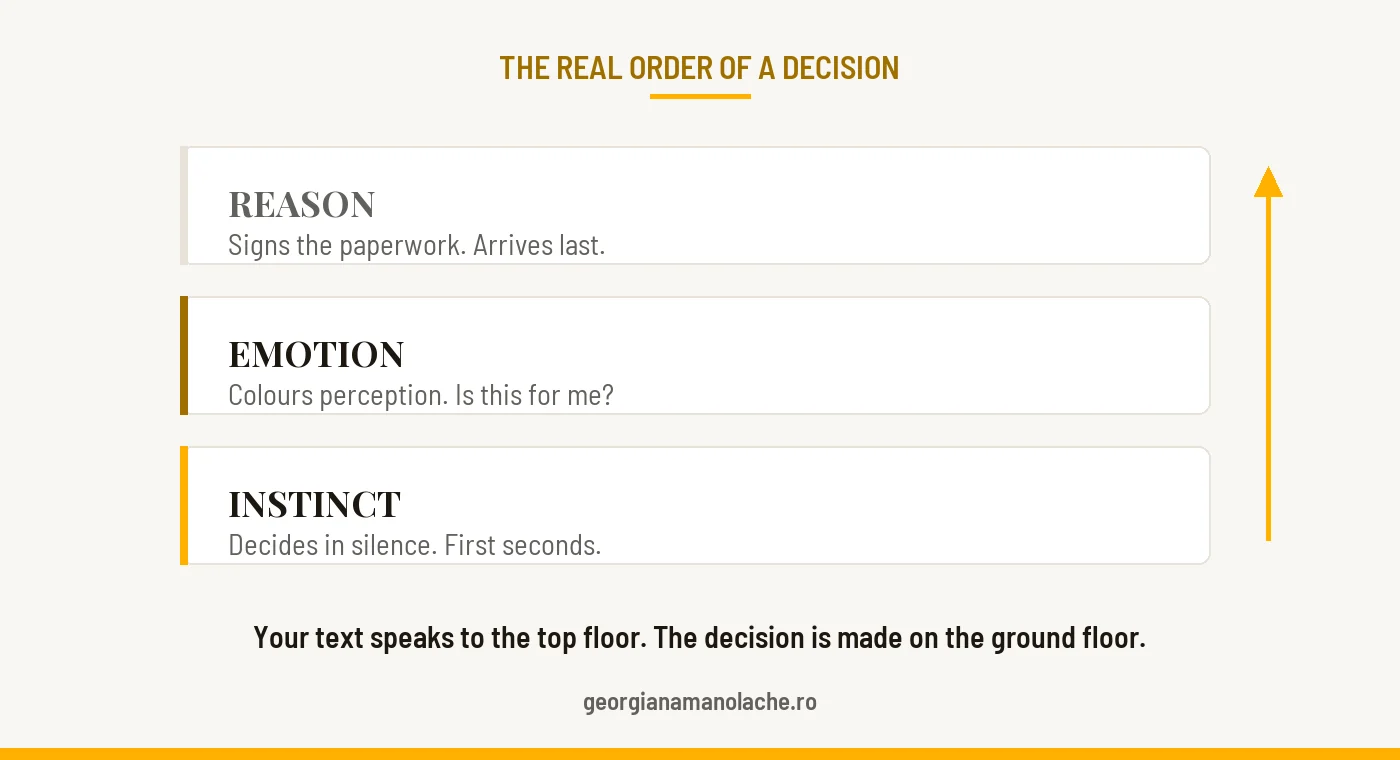
Daniel Kahneman, who won the Nobel Prize in 2002, explained that the mind runs two systems. One fast and automatic, which feels and decides without asking you. One slow and logical, which weighs, analyses and takes effort.
Guess which one decides when it comes to buying?
Instinct. The one that draws up no list of pros and cons. The one that feels something about you within three seconds and leaves it at that.
This is the trap we all fall into when we write our own pages. We build a tidy list of logical reasons, lay it out neatly and wait. Except that list speaks to reason, and reason arrives LAST. All it does is sign the paperwork. The decision was made seconds earlier, by instinct.
The same offer, two texts
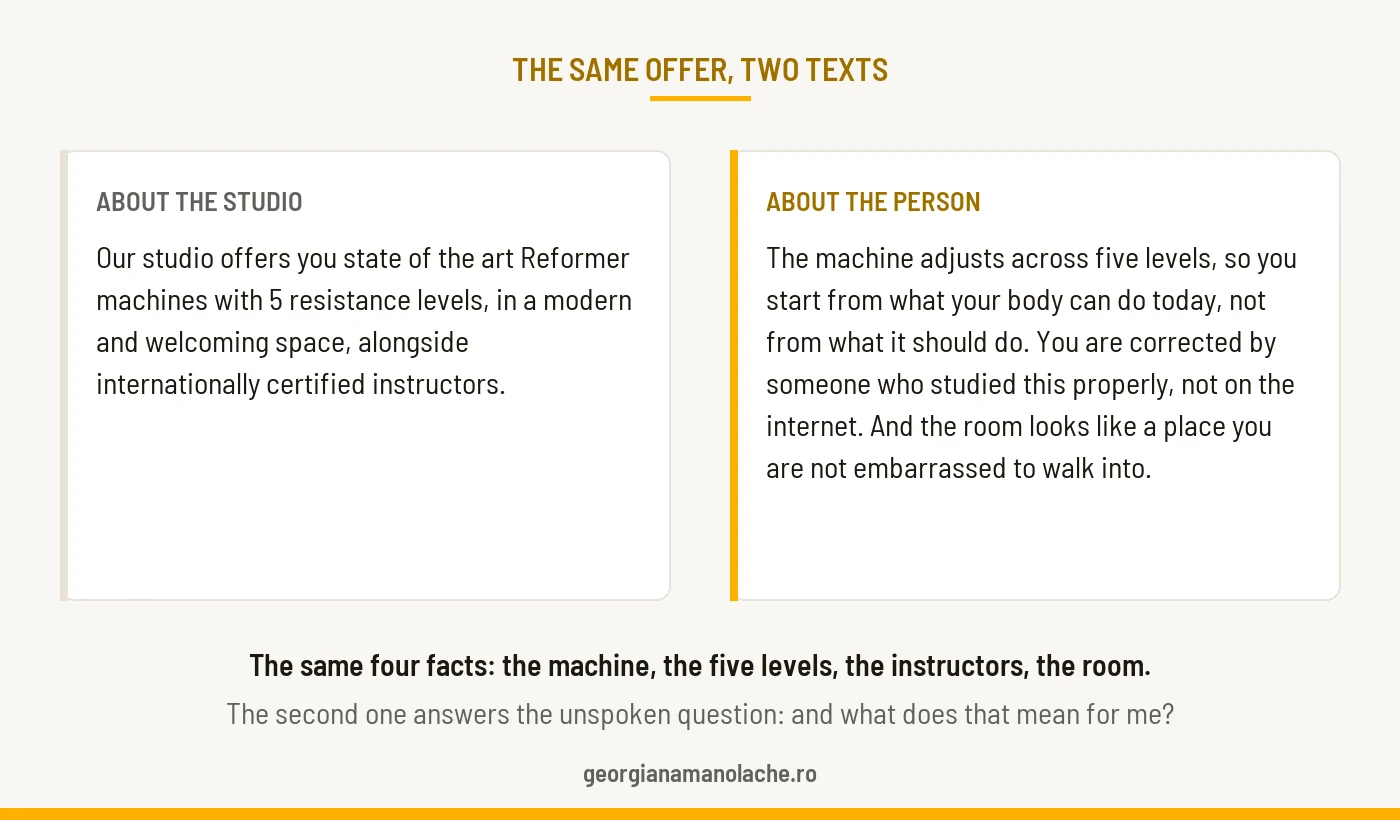
Read both and see which one would make you click.
Text one:
Our studio offers you state-of-the-art Reformer machines with 5 resistance levels, in a modern and welcoming space, alongside internationally certified instructors.
Text two:
The machine adjusts across five levels, so you start from what your body can do today, not from what it should do. You are corrected by someone who studied this properly, not on the internet. And the room looks like a place you are not embarrassed to walk into for the first time.
Look closely: these are the exact same four facts. The machine, the five levels, the trained instructors, the room.
The first text talks about the studio. The second talks about the person who has not exercised in years and is afraid of being the weakest one in the room. The first leaves the translation to them. The second hands it over.
I didn’t add a single new fact. I answered, with each one, the question people carry in their heads and never say out loud: and what does that mean for me?
That is the whole of copywriting, if you take only one thing from this article.
What copywriting is not
Copywriting is most often confused with content writing, with SEO and with good prose. Three different things, and each mix-up costs money.
Content writing is a different job. It produces articles and guides that teach and bring people to the site. Copywriting persuades them to take the next step once they are there. The article you are reading is content writing, like the guide to digital marketing for small businesses. The text on my services page is copywriting. You need both, at different points along the way.
SEO solves something else entirely. It makes sure your page gets found. Copywriting takes over after the click. I have seen sites that rank first on Google and sell nothing, because the text leaves the visitor cold the moment they arrive. The technical side shows up in a technical audit of the store; the text you can see with the naked eye.
Good prose is a trap. The most elegant sentence on the page is usually the first one to cut, because it draws attention to itself instead of carrying the reader forward. Rhythm and clarity stay, since they help the reading. The ornaments go.
All three are pieces of a larger machine. What that machine looks like, from identity through to measurement, I wrote in what marketing really is.
Why your text doesn’t sell
Most often for five reasons: the text talks about the company, it describes the product without saying what changes for the buyer, it picks nobody in particular, it addresses someone standing on a different step, or it asks for several things at once. I have audited enough websites to see the same problems come round again. Here they are, in the order I meet them.
1. You talk about yourself. The text opens with “We are a company with tradition” or with “Hi, I’m…”. I will admit the second one sat on my own front page until this spring, because until then I needed a digital CV rather than a commercial site. The person landing on your page arrives with a problem and very little patience. In those seconds they want to know one thing: does this get solved here? Your story matters, but later, to justify a choice they have already made.
2. You describe the product and stop there. “Reformer with 5 resistance levels” is a specification. “You get up in the morning without back pain” is a reason. The specification confirms the decision. The reason produces it. You need both, in that order.
3. You haven’t picked who you are talking to. Text written for everyone touches no one. When you try hard not to exclude anybody, you end up with wording so general that the reader cannot recognise themselves in it and leaves. The fear of losing someone is what makes you lose everyone.
4. You skipped the step the person is standing on. Eugene Schwartz described five levels of awareness in “Breakthrough Advertising” back in 1966, from the person who has no idea they have a problem to the one with the card already in hand. Ask for the order from someone who has just realised they have a problem and you lose them. Explain the problem to someone who only wanted the buy button and you lose them just the same.
5. You ask for too much at once. Call us, write to us, follow us, download the guide, subscribe to the newsletter. One text, one action. The rest is noise laid over the very thing you are waiting for.
What a text that sells looks like
A text that sells follows the order in which the decision is made, not the order in which you feel like telling the story. That order is fairly fixed, and it goes like this:
- The problem, in their words. The way they would say it on the phone to someone close, with your jargon left at the door.
- Proof that you understand the situation. This is where attention is won, and where most people lose it, because they rush to sell.
- What changes, concretely, with a picture the mind can see. “We increase your visibility” produces no picture. “People who searched for exactly what you sell start calling you” does.
- Proof that it works, placed early. Real numbers, a client describing what changed for them, a measurement. Not saved for the bottom of the page, where nobody gets to.
- One single request, plainly put.
And there is something the structure does not show: rhythm.
Short sentences after long ones. An idea that matters sits alone on its own line. When every sentence runs the same length, the text reads like a metronome and the mind checks out. That is how people are built, and it has nothing to do with being shallow.
How to learn copywriting from scratch
You learn it by writing and by measuring, in that order. The technique itself fits into a few days of reading. The craft comes from writing a page, looking at how many people did what you asked, changing the headline and looking again.
Except the part you learn first has to do with people, not with sentences: what makes them trust, why they pick the expensive option when the cheap one sits right beside it, what happens in their heads before any logical justification shows up.
I wrote a whole book about that mechanism, “Tell Them What They Want to Hear”.
The word “copywriting” never appears in it, and that is deliberate. The book starts from what happens in someone’s mind before they reach your text. Yet everything in it ends up in the text: writing exercises, the seven psychological triggers with the typical mistake next to each, one message turned into three forms for three channels, and a test you can run on your own page today.
The test goes like this: if the person you are writing for read your page, would they smile and say “this could have been written for me”?
If the answer is no, you write it again. Simpler. More human. More specific.
And if you would rather first see where your text stands right now, my services all start with an audit, and the first conversation is free. I will tell you honestly whether it makes sense or not.
Frequently asked questions
What is copywriting, in short?
Writing commercial text that produces a measurable action: an order, a phone call, a sign-up. It differs from ordinary writing in what comes after: the result shows up in numbers, not in opinions.
What is the difference between copywriting and content writing?
Content writing brings people to your site through articles and guides that teach. Copywriting persuades them to take the next step once they are there. A healthy business needs both, at different stages.
Can I learn copywriting without a formal qualification?
Yes. There is no compulsory diploma for this trade. You learn it by reading, by writing consistently and, above all, by following what your writing actually did.
How long should a text that sells be?
Long enough to cover what the person needs in order to decide, and not one word more. A page for a simple product can be short. A page for an expensive service needs far more, because it has more fears to answer.
Why doesn’t the text on my website sell?
Most often because it talks about the company instead of the customer’s problem, or because it asks for several actions in the same place. Both show up in an audit within minutes.
How much does a copywriter cost?
It varies widely, from pieces paid one by one to monthly retainers. The more useful question is a different one: what is the page that doesn’t sell costing you right now, counted in people who arrive and leave without doing anything.
About the author

Georgiana Manolache, 22 years in marketing and communication. I build the message and the path that bring you customers, not traffic without sales. I apply buyer psychology through a time-tested method, supported by AI tools.
I wrote the book „Tell Them What They Want to Hear” for entrepreneurs who want to be seen, heard, and chosen by the right customers, without pouring money into channels that have no strategy.